
Sunday, July 8, 2012

The Offer Sheet, or: How I Learned to Stop Worrying and Love the Shea Weber (Contract) Bomb

If David Poile looks like this after losing Ryan Suter, imagine what happens if he loses Shea Weber. Full fledged zombie Poile.
Photo credit The Tennessean

This was supposed to be the biggest offseason in a decade. The Red Wings added three future Hall of Famers to their roster the last time they were in a period of transition that even remotely resembles this one. What have they done so far this summer? Added a solid backup goalie, an agitator with little offensive upside, a flashy but unproven European star, and a player who was not resigned by Detroit the last time he reached free agency. Not exactly the blockbuster summer everyone was hoping for.

Drastic times call for drastic measures, and if ever there was a drastic time this is it. Chris from Nightmare on Helm Street wrote an interesting article about signing Shea Weber to an offer sheet. I like his idea of throwing out an offer that David Poile can't match, but what will that take? Is there a way we can precisely pinpoint a number that Poile can't match, thereby pushing him over the brink of insanity that he's already teetering on?

The most difficult part of signing Weber to an offer sheet is Nashville's available cap space. They have about $30 million left to spend, which is essentially a blank check. Some of that $30 million will disappear soon, as Poile doesn't have a full roster at this time. Let's take a look.
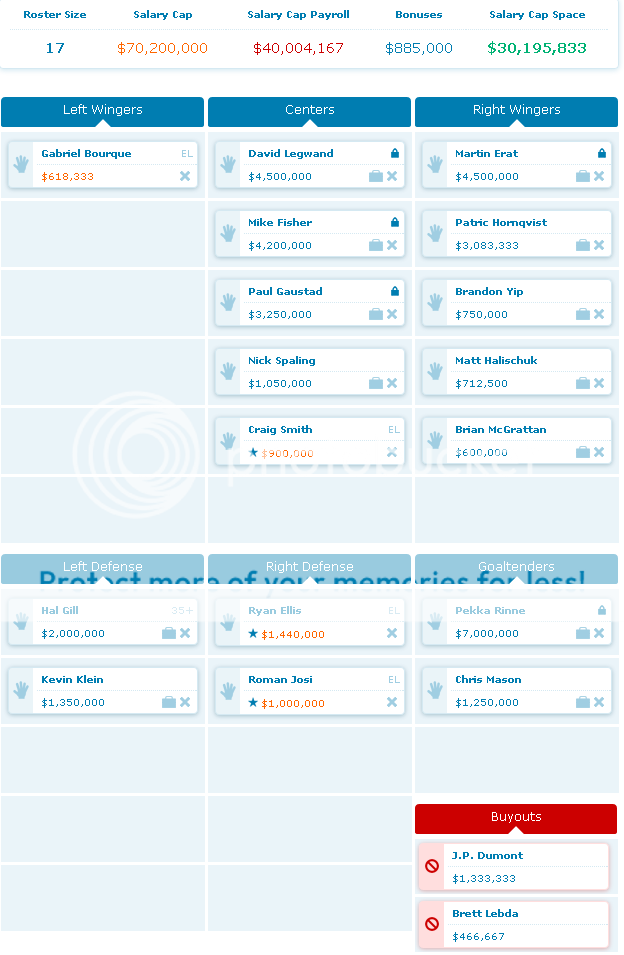

I then tried to predict moves Nashville will make and see how much cap space was left. Winger Sergei Kostitsyn filed for salary arbitration, and they'll likely re-sign him at a higher salary than the $2.5 million he made last season. I gave him a modest raise since his production did slip, so let's assume he earns $3.00 million next season. There's a big need for help on defense, so I extended qualifying offers to Jonathon Blum and Teemu Laakso. Colin Wilson is one of the Predators' more promising young players, so let's say they sign him to a deal with a cap hit of $1.825 million, similar but slightly above his current $1.725 million hit. This still leaves Nashville with only two left wingers, and six centers. I'll be nice to them and say that they don't have to sign two left wings, but instead convert a center. This means they still have to acquire a left wing, and I'll assume they do this via free agency. They could use a veteran leader with some scoring punch, so let's say they sign Andrew Brunette to a one year, $2.2 million deal. After all this, they've still got $21.633 million in cap space.
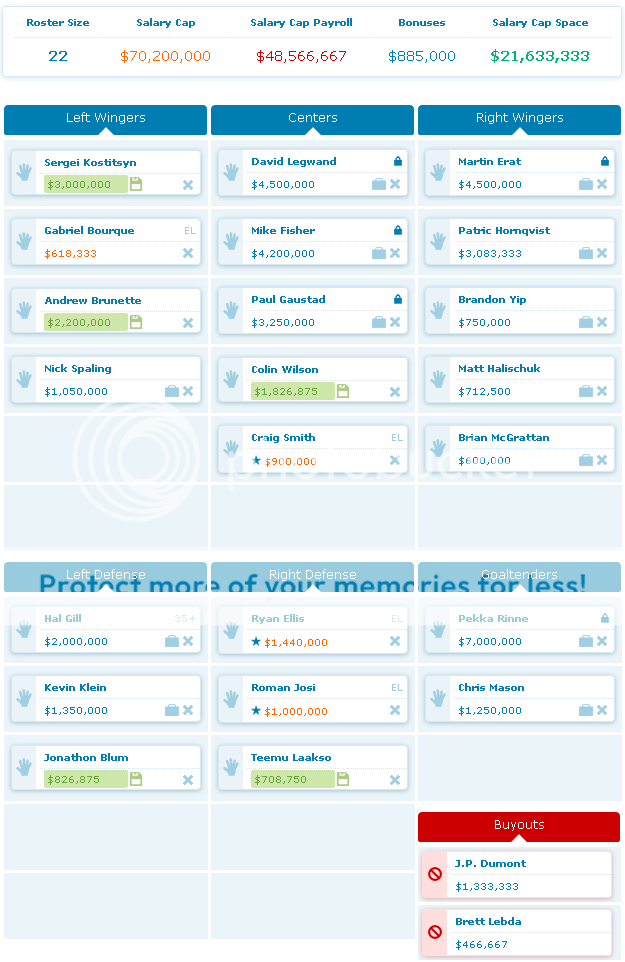

With that much cap space, we have to be realistic. There's a very, very good chance that Nashville matches any offer another team puts on the table that's short of a one year, $22 million deal. This is their franchise player and captain, and the organization is feeling even more pressure to keep him after the departure of Ryan Suter.

Regardless, Detroit can still put Nashville in a tremendously uncomfortable position. As far as the contract offer itself, I think Detroit can afford to put a $12.2 million deal on the table. To calculate this number, I first assumed the Wings resign Justin Abdelkader for $1.3 million per season, and Kyle Quincey for $3.78 million per. I took the Quincey figure from the contest running over on The Production Line, and the Abdelkader salary is one that I've heard he's looking for. This means that Detroit ends up with $100k if Weber doesn't get matched, and also puts them one player over the maximum.


The roster is overloaded with forwards, and someone will either have to be sent to Grand Rapids or traded to bring the roster down to the maximum of 23. Trading a forward for draft picks would help, because if Weber signs with Detroit and isn't matched the Wings will lose four first round draft picks. The likely candidate to take his turn apprenticing in Grand Rapids is Damien Brunner, despite being billed as a top six forward by Mike Babcock. He's one of the two forwards with two way contracts, and is unproven in the NHL. 


So if Nashville has a blank check, why even try?


The facts don't exactly pain a rosy picture from the Wings' perspective. Only one player has ever signed an offer sheet and not been matched by his current club post-lockout, but Detroit has absolutely nothing to lose and a whole lot to gain. The Wings wanted to add a top six forward and a first pair defenseman in the offseason. There aren't any top flight defensemen left on the open market, and perhaps only Keith Yandle available on the trade market.. Forwards are more available, and Detroit's forward crop is a lot stronger than their blue liners as the roster stands now. If you prioritize needs, an elite defenseman is far and away the Wings' greatest void.


Enter Weber. A Norris trophy nominee the past two seasons, he's a true top pair guy who plays a great offensive and defensive game. Nicklas Lidstrom is absolutely irreplaceable, but I think Weber is a step closer to filling those skates than even Ryan Suter would have been. 


For once, Detroit has leverage. They had none with Suter and Zach Parise, instead having to wait and hope against hope that one of them would chose Detroit as the issuer of their paychecks for the next decade plus. The Wings now have an opportunity to be the aggressor and show that they are in no way rebuilding, but instead are looking to reload and make another run for the Cup.


So, let's say the Wings give Weber an offer sheet. What's next?


What's the worst that could happen? They put a huge offer on the table and Weber turns it down. At the very least he knows that Detroit sees him as a part of their future plans, and should he make it to free agency in 2013 he knows we'll be right there waiting to hand him a long term deal. If Nashville matches, it guarantees he becomes a free agent in 2013 and the same scenario is in play; Mr. Weber, here's the vault. Help yourself.


Let's say Weber signs the offer sheet, and Nashville doesn't match. After all, they've got to lock up Patric Hornqvist to a long term deal in the next year, as he's one of the few scorers they have. Beyond Hornqvist, take a look at this. It speaks for itself.


That's a lot of free agents. Best case scenario? Weber signs, and Poile can't or won't match. Detroit gets one year to enjoy the services of a top five blue liner, and also gets a year to impress him and hopefully sign him for the long haul.

Ken Holland is obviously smarter than you, ya blogger. There's gotta be a catch.

There's one caveat to the Weber contract. We can't continue to pay him $12.2 million over a multi-year deal. Sure, there's money to throw out this offseason, but who knows what the next CBA will bring. Weber's signing would have to (or at least should) come with a gentlemen's agreement that, should Weber become a Red Wing, he'd have to take less to stay here after 2012-13. Not the whole "we're the Wings so everyone should want to play for us because mystique original six Gordie Stevie blah" discount, but down to fair market value. I wouldn't have a problem making Weber the highest paid defenseman in the league, so perhaps we could mention that a new contract would have an annual cap hit of about $8 million.

Pssh, this isn't Detroit's kind of move. They preach patience, there's no way they do this.

It's true, as an organization patience has been a virtue for a long time. I have no problem with that, as I appreciate patience and think that panic button moves can get you in over your head quicker than you could every imagine. There comes a time, however, where patience has run it's course. Detroit has been extolling the virtues of waiting for over a year now, and in that time little has been done to make the team better. It's time to use some of the cap space that has been saved up on a player worth the inflated salary handed out to free agents this offseason.

Why is now the right time?

Weber's stunned, Poile's stunned, most of Nashville is probably stunned. Now's the time to make a bold move. Something needs to be done to quell the nerves of a fanbase that has seen the last links to the glory of the late nineties and two thousands walk away slowly put surely over the past few seasons.

If you're wondering why the face of Nashville hockey would contemplate signing with their biggest rival, take a look at this post from Puck Daddy. It nicely summarizes some of the reasons he may look elsewhere. Nashville isn't exactly getting a ringing endorsement from his agents, that's for sure

About that other forward....

If you think that the Wings shouldn't pursue Weber but should instead sign Shane Doan or Alex Semin and look for another defenseman elsewhere, I understand your stance. However, I ask you this; would you rather see Shane Doan in a Wings jersey for a couple of seasons, or one of the top five defensemen in the league patrolling the blue line for one year, with a possibility of keeping that player in Detroit for years to come. I've always been a defense-first guy, so I'm putting my money on the latter. Now all we can do is sit back and see whether the Wings' front office feels the same.

Like it? Hate it? Let me know (and follow me) on Twitter @TOGBlog1 or by email at theoctopigarden@gmail.com

Tuesday, July 3, 2012

Welcome to Detroit: Damien Brunner

Damien Brunner looks like one of the Backstreet Boys and heals sick children. Watch out, Dos Equis guy.

Articles? Articles!

Brunner has never played an NHL game, so there are no advanced stats to put in this space. Instead of numbers, you're going to get words.Words, and a lot of links.

  • Looking for a quick scouting report? According to eliteprospects.com, Brunner is "a slick offensive forward who can shoot as well as pass the puck. Has great wheels and hands. Plays a gritty game."
  • Mike Babcock didn't shy away from praising Brunner. Seriously, we're talking Helm-like praise here [Ed. note: it's almost impossible to write a sentence with "praise" in it and not accidentally write "Parise." Please note that this was written on the third day of free agency insanity, a time in which flightaware.com has become a major player, along with a cow from Ryan Suter's farm]. It's worth reading the article for Babcock's full quote, but he mentions that he envisions Brunner being a top 6 forward for Detroit, and it sounds like he means this coming season. Babs likes Brunner's right-handed shot on the powerplay, though the signing of fellow right-hander Mikael Samuelsson may take away some of the PP time Brunner would have gotten if he made the big club.
  • Ken Holland shared Mike Babcock's enthusiasm, saying that Brunner will get a chance to play with Detroit's best players and see where it goes. Though it's pure speculation at this point, the natural extension of this is for Brunner to get some preseason time on both Pavel Datsyuk and Henrik Zetterberg's line.
  • A more thorough scouting report from Red Wings Central shares some of the same sentiments I had after watching film of Brunner; great skater, good shot, intelligent shooter, and a phenomenal stickhandler at full speed. 
So what's the verdict?
This could be another one of Detroit's under-the-radar acquisitions of top European talent at a bargain, even though it wasn't via the draft in this instance. The Wings' European scouting staff got the attention of Ken Holland and Mike Babcock in a year that just happened to feature a World Championship. This perfect storm of events allowed Brunner to showcase his talent against top players, in addition to allowing Holland and Babcock to get an up close and in-person look. This may be the one and only reason to be thankful for Detroit's first round exit.

In short, there's a whole lot of potential here without a whole lot of risk. According to Cap Geek, Brunner signed a one year, $925,000 deal with a cap hit of $1.35 million. Not a bad deal at all for a player who is something of a known quantity to the Wings. Though it's difficult to tell how his game will translate to a smaller rink, Brunner has competed against NHL-level competition in the World Championship and performed at a point-per-game pace. I may end up looking really stupid in a few years (thanks for archiving everything, Google) but I believe that Brunner could be the next Valtteri Filppula, and has the upside to be the next Datsyuk or Zetterberg. I see him as more of a Datsyuk or Zetterberg in terms of skill, but he needs to work on his defensive game is he wants to be more than just another top six forward.

As for this coming season, I view it as feast or famine for Brunner. Either he makes the Wings and earns a spot among the top six forwards, or he goes the traditional Grand Rapids apprenticeship route. I don't see any sense is letting him toil on the third or fourth lines, or even worse, playing sporadically or sparsely. Brunner could use time to develop and adjust to the North American game/rink, and if he's talented enough for that development to take place at the NHL level then so be it. If it needs to take place in Grand Rapids then that's okay too, though Detroit may have been more comfortable with this option if Brunner was signed to a multi-year deal.

Video
Some of these have soundtracks comprised of hard rock that is in English, and others have soundtracks comprised of hard rock that is not in English. Listen at your own risk.


Like it? Hate it? Let me know (and follow me) on Twitter @TOGBlog1 or by email at theoctopigarden@gmail.com

Monday, July 2, 2012

Welcome to Detroit: Jonas Gustavsson

Image via thestar.com
The first of four Detroit signings on the opening day of free agency, Jonas "The Monster" Gustavsson escaped the villainous reign of Toronto's Francois Allaire, and in the process left the "center of the hockey universe" for Hockeytown. Jim Bedard and company will have an opportunity to work with a goaltender who wanted to "keep [his] development going in the right direction."

Numbers? Numbers!
  • Let's start with the basics. Gustavsson was 17-17-4 in 2011-12 with a 2.92 GAA and .902 save %.He allowed 112 goals on 1,147 shots faced.
  • Time for the heavy duty mumbo jumbo. At even strength, Gustavsson allowed 2.83 goals/60 while facing 26.8 shots against/60.
  • When he was off the ice, Toronto allowed 5.58 even strength goals/60 on 17.9 shots against/60.
  • Gustavsson was supported by 24.6 shots for/60 while on-ice, though Toronto put 33.2 shots for/60 on net when the Monster was on the bench.
  • What's the point of all of this? Essentially, the Maple Leafs played worse in front of Gustavsson at even strength than they did when someone else was between the pipes. This means that his numbers may be a bit skewed. 
  • The next set of numbers comes from stats.hockeyanalysis.com, a site which I commonly use when looking at skaters. Honestly, I've never used it for goalies and won't pretend to be an expert here. The one thing I do know is that the more years we group together the more reliable the information, and that 1.0 is an average rating for HARD+. Someone has a HARD+ of 1.136? They perform 13.6% better than an average player. HARD+ of 0.89? They're performing 11% below average.
  • From 2009-12, Gustavsson's HARD+ at even strength (zone start adjusted) is 0.850. Everything listed below will be from the same period of time.
  • In tied games, his 5v5 zone start adjusted HARD+ is 0.876. When up 1 goal, his 5v5 zone start adjusted HARD+ is 0.888. Up 2 goals, and his 5v5 zone start adjusted HARD+ falls to 0.742.
  • Down 1 goal at even strength, his HARD+ is 0.706. Ouch. Down 2 goals he's a little better, with a HARD+ of 0.769.
  • On the powerplay, Gustavsson's HARD+ is 1.316. Woot no shorties! I guess. Short handed, his HARD+ drops to 0.796. 

So what's the verdict?
Looks like we've got ourselves a backup goaltender who could be anywhere between "good" and "serviceable." I see two differences between Gustavsson and former backup Ty Conklin. First, Gustavsson is young and generally considered to have a great deal of potential that can still be extracted under the watchful eyes of Jim Bedard and Chris Osgood. Conklin came back for his second tour of duty in Detroit on his last legs and in the twilight of his career. Second, Gustavsson's HARD+ numbers are fairly consistent across situations, especially when compared against Conklin's numbers. Check out Conklin's stats here, and you'll see that he's either good or absolutely abysmal. I'll take the younger player with potential and consistency over the inconsistent veteran any day. No disrespect intended to Conklin, as I liked him in his first stint with the Wings and rooted for him in his second. At this time, however, a change had to be made, and I think that Ken Holland went in the right direction.


Videos
You'll probably want to watch this on mute


Weird begining, but a lot of good SEL film


Like it? Hate it? Let me know (and follow me) on Twitter @TOGBlog1 or by email at theoctopigarden@gmail.com


Wednesday, June 27, 2012

Shana-hold On

This morning, the topic of discussion on NHL Home Ice radio naturally turned to Hall of Fame nominees. The hosts said there were two shoo-ins; Joe Sakic and Brendan Shanahan. They then debated the merits of Adam Oates, Pavel Bure, and Mats Sundin. 

Four out of five of the aforementioned players will be a part of the Hall's 2012 class, with the only player left out being one of the shoo-ins. A lot of Red Wings fans are upset, and deservedly so. Need to alleviate some frustration? Watch this:


Sniper, comedian, and league disciplinarian. Brendan Shanahan: renaissance man.

In blog related matters, I apologize for not having any draft coverage this year. It coincided with moving, and I was too busy packing and unpacking to get anything pulled together. Luckily, there are a lot of other great Wings blogs that did a phenomenal job of covering it all. I'll be posting lengthy "Welcome to Detroit" posts for all of the Wings' free agent signings, so be sure to check back on Sunday.


Thursday, June 14, 2012

Sign on the Dotted Line: A Brief Look at the Red Wings' Free Agent Targets

I wanted to create a resource where a relatively brief summary of each of Detroit's free agent targets was housed on one page. Hopefully this is helpful for those interested in a little more in-depth info about the talent pool available. I'll be updating this frequently leading up to July 1st, so check back for more.


Forwards


Zach Parise: See my post here.

Alexander Semin: Most things I've heard have been less than favorable, but there's definitely something intriguing about him. If you're looking for something more qualitative, it's the chemistry he had playing with Pavel Datsyuk at Worlds. If you're looking for something more quantitative, it comes from stats.hockeyanalysis.com. Basically, a HARO+, HARD+, or HART+ rating above 1 means the player exceeded expectations, and a rating below 1 means they underperformed given their circumstances (ice time, linemates, and defensive ability of opposition). Semin's even strength HARO+ (offense) is 1.289, his HARD+ (defense) is 0.996, and his HART+ (total) is 1.143. According to behindthenet.ca, he had the third highest Corsi rating of Capitals forwards (5.21), which means he gets shots to the net more frequently than he allows them. This fits nicely with the Wings possession system. The biggest issue with him? His contract. He'll have to take at least a slight paycut from the $6.7 million he made last year.

Defensemen


Ryan Suter: The last part of my post needs to be updated, but the stats are all there and worth checking out.

Dennis Wideman: His even strength numbers aren't great (HARO+ 0.972, HARD+ 0.951, HART+ 0.961). Played over 150 minutes more than any other Washington d-man on the powerplay and had a good HARD+ (1.123). Logged 158 minutes of penalty kill time and had a better HARD+ (0.855) than teammates Karl Alzner (215 minutes, 0.623 HARD+) and John Carlson (200 minutes, 0.627 HARD+). Played in all situations, but was a secondary option on the penalty kill and played against easier competition (Relative Corsi Quality of Competition of -1.039). I'd take his 11 goals, 35 assists, and 46 points in a heartbeat if the price was right, regardless of whether Suter signs with Detroit. He's a right handed shot as well, which the Wings could use.


Jason Garrison: A big body (6'2", 218 lbs), he's a defensive defenseman that could fill the void left by Brad Stuart. Great even strength HARD+ (1.233) against strong competition (second highest Relative Corsi QoC of 1.015). Played second most PK minutes among Panthers defenders against the toughest competition (Relative Corsi QoC of 2.937). At 27 years old and with only 3 full season under his belt, he's just starting to come into his prime. Due a huge raise from the $700,000 he made last year. I'd love to see him wearing the Winged Wheel next season.


Matt Carle: He has good possession numbers, evidenced by positive on-ice Corsi at even strength, on the powerplay, and on the penalty kill. Achieved these against mediocre competition across those same situations. Didn't play a lot on special teams. At even strength, his numbers are mediocre (HARO+ 1.079, HARD+ 0.928, HART+ 1.004). Made $3.8 million this past season, scored 4 goals, and added 34 assists. I think that the Red Wings' money could be better spent elsewhere, and that signing Carle means that all of Detroit's negotiating with each of the above players fell through.

Coming soon: more forwards, goaltenders

Tuesday, June 12, 2012

15 Years Later: What Could Have Been, and What Really Matters

The scene inside Joe Louis Arena's Olympia Club was an emotional one. Employees were dressed in red #16 sweaters, a reminder of the number that will soon hang from the rafters with other Red Wings legends. Vladimir Konstantinov is retiring from the game of hockey after one final Stanley Cup championship, his fourth, at the age of 41. The last of the Russian Five is gone, and one of Detroit's most dominant eras may be coming to a close. He leaves the game having cemented his legacy as one half of the greatest defense pairing of all time, the man who traded the majority of the last decade's Norris Trophies with defense partner Nicklas Lidstrom like they were starting a D-to-D breakout.


It's hard to imagine, and yet it's not much of a stretch. Konstantinov was just hitting his stride during the 1996-97 season, and in many ways was overshadowing teammate, living legend, and future Hockey Hall of Famer Nicklas Lidstrom. "If you asked 100 people back then to name our best defenseman, it would be about even," Red Wings GM Ken Holland told ESPN The Magazine in 2008. "But a few more might have said Konstantinov."

Konstantinov was coming off a season in which he was a Norris trophy finalist and finished runner-up to Brian Leetch. His combination of skill and grit was a perfect fit for a city well known for embracing blue collar players.

"Sometimes, we sit around and reflect internally," Holland told the Free Press in 2007. "Where would we be if we'd had a healthy Konstantinov?"

*********************************************************************************

On the evening of June 13, 1997, a white limousine carrying three members of the Detroit Red Wings organization streaked through the dusk and collided with a tree at 50 miles per hour. The driver, Richard Gnida, was driving with a suspended license and had previously been twice convicted of driving under the influence. He claims to have blacked out during the incident. Gnida never heard the passengers banging on the partition to try and get his attention.

Konstantinov and team masseur Sergei Mnatsakanov both sustained closed head injuries. Defenseman Slava Fetisov walked away with relatively minor injuries and rejoined the Red Wings the following season.

Mnatsakanov is mentioned less frequently than Konstantinov, but his story is just as tragic. He shares many similarities with Konstantinov. Both had defected from Russia, and both were living their dream; to be in the National Hockey League. The two had just ascended to the pinnacle of their profession when, six days later, their lives changed forever.

The limousine accident is the tarnish on the silver chalice for Detroit. It's impossible to think about the 1997 championship without thinking about the accident. The two are inextricably linked.

Who knows what could have happened if the accident never occurred? Does Konstantinov go on to reach the sustained level of brilliance so many think he could? Does Mnatsakanov become a

Could-haves and should-haves are intriguing thoughts, but dangerous as well. One thing, however, is certain. The Red Wings repeated as Stanley Cup champions in 1998, driven by tragedy, motivated by the loss of a teammate and a member of the organization.

Konstantinov and Mnatsakanov's impact extends beyond the hockey world. They reminded the world at large of the fragility of life, that no matter how high a pedestal you're put on you can always be taken back down. Most importantly, the two men showed us the power of collective belief in overcoming daunting circumstances. Konstantinov and Mnatsakanov both sustained life-threatening injuries. Today, Konstantinov is able to use his walker and Mnatsakanov his wheelchair to attend games at Joe Louis Arena. They will forever symbolize not just what it means to be a Detroit Red Wing, but what it means to be a courageous human being.

The patch that adorned Detroit's jerseys throughout the 1997-98 season summed it up in two languages and one word: believe.


Like it? Hate it? Let me know (and follow me) on Twitter @TOGBlog1 or by email at theoctopigarden@gmail.com

Friday, June 8, 2012

Free Agent Forecasting: Zach Parise (Revised 6/8/12)


Looks good in red, no?

When Mike Babcock laments the lack of forward depth, you know it's time to make some changes. When he offers to fly around the country to recruit free agents, you know that Detroit is in dire straits. Most believe that New Jersey winger Zach Parise will be near the top of the Red Wings' list of targets when July 1st rolls around, giving Detroit the additional offensive punch they lacked during the playoffs. Is Parise worth wooing, and what might it take to land him?

Let's assume that Valterri Filppula isn't moved during the offseason. That means that Detroit's top six forwards could look something like this on opening night of the 2012-13 season:

Nyquist-Datsyuk-Franzen
___?___-Zetterberg-Filppula

It may be a bit of a stretch to put Nyquist on the top line, but the chemistry he had with Pavel Datsyuk is hard to deny, and it seems silly to bury him in the bottom six with the type of playmaking ability that he possesses. This leaves one spot to be filled, and Parise could be slotted in quite nicely there. The first line has a Hart trophy caliber player in the middle, and the second line has three potential all stars. Not a bad top six.

Though he may still be playing hockey with a team that's not the Detroit Red Wings, let's take a look at what Parise could bring to the organization.

Statistical Breakdown


Basic Stats

  • Parise played in all 82 games this season, scoring 31 goals and adding 38 assists for a total of 69 points. Seven of his goals came on the powerplay, and three were short handed tallies. Average time on ice was 21:29 (16:05 even strength, 3:26 powerplay, 1:57 shorthanded). 
  • Took 293 shots. Blocked 39 shots. 35 givesaways were offset by 65 takeaways. 
  • He was a -5 on the year. Weird stat of the day: 16 of his 32 penalty minutes came from tripping calls. 
Advanced Stats
  • Parise's even strength Relative Corsi Quality of Competition is 0.731. Essentially, the higher the number the better the competition faced. For context, we'll look at some of the top players (by reputation) in the league. Datsyuk (1.169) and Claude Giroux (0.805) faced tougher competition, while offensive dynamos like Steven Stamkos (0.248) and Evgeni Malkin (0.279) racked up their numbers against relatively weaker opponents. An interesting case is current teammate Ilya Kovalchuk (0.533). Though Kovalchuk had 15 more points than Parise, it was Parise who was drawing the tougher defensive assignments. The closest Red Wing is Jiri Hudler (0.789), the very player that Parise could be replacing.
  • On-ice Corsi rating isn't as kind to Parise, and this is true for all of his Devils teammates. Corsi measures the shot differential (goals+saves+blocked shots+missed shots) per 60 minutes of even strength ice time. Parise (3.22) pales in comparison to guys like Datsyuk (19.08), Malkin (17.69), Toews (17.17), and even Joe Pavelski (12.32), but then again the highest Corsi on New Jersey belongs to Alexei Ponikarovsky (7.84). This is likely more indicative of the system utilized by New Jersey instead of a flaw in every single player on the Devils' roster. 
  • Parise averages 0.99 goals, 0.71 first assists, and 0.47 second assists for 2.18 points every 60 minutes of 5v5 time he's on ice. To compare, Giroux (1.02, 1.02, 0.70 for 2.73), Datsyuk (0.82, 1.00, 0.65 for 2.47), and Malkin (1.88, 1.42, 0.36 for 3.66) all average more, but only Malkin is averaging significantly more points. For fun, let's look at the Wings' last big free agent signing, Marian Hossa. His averages (0.92, 0.92. 0.72 for 2.56) are similar to top tier players like Giroux and Datsyuk, and if Parise raised his second assist average he'd be in the same category.
  • Offensive zone start percentage isn't the be-all end-all of advanced statistical analysis, but is useful in determining how a coach views a player. If a guy's offensive zone start % is low (30-40%) then he's likely being used as a defensive specialist, while a player whose offensive zone start % is 60% or above may be viewed as a defensive liability. Parise's number (54.2%) is nothing earth-shattering. He's not being shielded from having to defend, and he's not being put on the ice solely to check. This is about what you'd expect from a good two way forward like Henrik Zetterberg (54.5%) or Datsyuk (55.5%).
  • Two statistics that I find interesting are +/- On-Ice/60 and +/- Off-Ice/60. The first looks at the average goals for per 60 minutes of even strength ice time and subtracts average goals against per 60 minutes of even strength ice time from it. The latter does the same for the team when a player is off the ice. Parise's +/-On/60 is -0.14, and his +/-Off/60 is -0.18. New Jersey allows 0.14 more goals than they score for every 60 minutes of even strength time Parise plays, while they allow 0.18 more goals than they score when he's off the ice. In other words, Parise's team is negligibly better when he's on the ice compared to when he's riding the bench. While this isn't the ringing endorsement of impact that a high +/- On/60 can provide, it isn't singularly damning either. 
  • Let's look at +/-On/60 and +/-Off/60 for Parise's powerplay numbers. His +/-On/60 is 4.75, and his +/-Off/60 is 2.68. The New Jersey offense is receiving a significant boost when Parise is on the ice with the man advantage. Keep in mind that Parise averages almost 4 minutes per game on the PP, so this is a statistic worth noting.
  • Parise also plays on the penalty kill, averaging almost 2 full minutes per game. His +/-/60 numbers, however, are brutal. A +/-On/60 of -2.64 and +/-Off/60 of -0.91 is alarming enough that I dug a little deeper. Though it looks like the Devils are much worse off with Parise on the penalty kill than if they kept him on the bench, he's actually playing the second most time of any NJ forward (1.94 minutes per 60 played; Dainius Zubrus plays 1.95). He's scored three of the six shorthanded goals he was on ice for, but was also on ice for 13 goals against. I think the ice time entrusted to Parise speaks more to his skill than the +/- stats do.
  • Hockey Analysis has a unique way to look at the offensive, defensive, and total production of players. Here's the abbreviated explanation from their website (the rest of the article can be found here):
Given a large enough sample size of ice time with and against players I believe that we should have a reliable rating system in which any HARO, HARD, or HART greater than 1 indicates the player is a better than average player and anything under 1 indicates the player is a below average player. 
  • Parise's even strength HARO+ (1.083), HARD+ (0.914), and HART+ (0.998) are all respectable and fairly close to the benchmark of 1. For comparison, we'll again look at Datsyuk (1.240, 1.404, 1.322), Zetterberg (1.366, 0.897, 1.131), Malkin (1.542, 0.898, 1.220), and Giroux (1.376, 0.920, 1.148). While all of those players have higher offensive ratings, it appears that Parise is a better even strength defender than Zetterberg and Malkin and about as good as Giroux.
  • Parise's powerplay HARO+ (1.159), HARD+ (0.601), and HART+ (0.880) are similar to Zettberg's (1.024, 0.681, 0.853). Datsyuk (1.327, 2.965, 2.146), Malkin (1.345, 0.632, 0.988), and Giroux (1.302, 0.636, 0.930) aren't favorable comparisons in this instance.
  • The penalty kill is where Parise shines. His HARO+ (2.406), HARD+ (0.913), and HART+ (1.660) are all much higher than Zetterberg (0.756, 0.677, 0.717), Datsyuk (0.000, 1.065, 0.533), Malkin (not used on PK), and Giroux's (0.720, 0.771, 0.745).
  • Perhaps the biggest strength of hockeyanalysis.com is the ability to look at HARO+, HARD+, and HART+ over multiple seasons. Five seasons of data (2007/08-2011/12) tells us that Parise is truly a two way star. Keeping in mind that anything over 1 is an above average player, Parise's even strength HARO+ (0.976), HARD+ (1.129), and HART+ (1.052) are impressive.
  • Five year powerplay HARO+ of 1.223, HARD+ of 0.894, and HART+ of 1.058 is great.
  • Five year peanlty kill HARO+ of 2.929, HARD+ of 1.412, and HART+ of 2.170 is especially noteworthy.

Contract


Parise signed a one year, $6 million dollar deal in the summer of 2011 that helped avoid arbitration, but also allows him to test the waters of free agency once he has played out the season. He had a successful, if slightly subpar, regular season in 2011-12 (according to comparisons against five year averages of HARO+, HARD+, and HART+). Despite this, I don't expect Parise's paycheck to get any smaller.

I wouldn't be surprised if he signs a deal for around $6.5 million per season. The cap hit could be structured to be somewhat similar to Henrik Zetterberg's at slightly over $6 million per season. At this salary and cap hit, I'd sign Parise.

I don't see him as a part of the upper echelon of players in the league, and the comparisons above make this fairly obvious. At the same time, and all else being equal, he would have been the only 30 goal scorer on the Wings this season. He's a very talented player, someone I'd put in the same neighborhood as Zetterberg. It seems fair that they would then be paid accordingly; similar deals for a similar skillset.

The only disturbing thing that I saw when going through the numbers was that nothing really stood out on the advanced statistics side of things when comparing him to New Jersey's other forwards. While Parise almost had a 70 point year, he wasn't clearly and distinguishably the best player on his team in any one category. If the bidding for him gets out of hand, I'd let him sign elsewhere. At $7 million a season I think his contract turns into a burden despite his talent, especially keeping in mind that Datsyuk only makes $6.7 million per season and was better in most advanced statistical categories.

Estimated Contract: $7-7.2 million/yr
Estimated Value: $6 million/yr

Can Detroit Sign Him?


In short, yes.


A quick disclaimer: I'd rather have Nick Lidstrom on this roster than any other player in the league. Period. It's been said over and over again, but there's no way you can replace him. Life goes on and, despite the stomach-knotting absence of the seven time Norris winner's name from the roster, there is still a roster with glaring deficiencies to fill.

I changed my earlier projection for Parise's salary and adjusted it to be closer to Pavel Datsyuk's. As time goes on, it's becoming more and more evident that this year's free agent crop is 1a) Parise 1b) Suter 234442) everyone else. A weak crop goes hand in hand with bloated salaries, and that's what the Wings will be encountering if they're looking to add help via free agency. 

The good news? Detroit is well equipped to take on a boatload of salary and still have room to work with. If the Wings were to sign Suter and Parise to deals with a $7 million cap hit, they would still have almost $7 million in cap space. And that's assuming that Helm and Abdelkader get small raises, and Quincey signs an Ericsson-like contract. There's no need to worry about cap space in Detroit. There's enough to sign both of the most desirable free agent targets, and hang onto Detroit's home grown talent. Salary won't be the culprit if Parise chooses not to sign with Detroit.

Like it? Hate it? Let me know (and follow me) on Twitter @TOGBlog1 or by email at theoctopigarden@gmail.com

Stats via behindthenet.ca and hockeyanalysis.com. Salary cap info via capgeek.com